How to Move a Forklift for Beginners Step by Step Guide
Moving a forklift as a beginner can feel overwhelming, but this step-by-step guide breaks it down into simple, easy-to-follow stages. You will learn pre-operation checks, forklift controls, safe driving techniques, and common mistakes to avoid. Whether you work in a warehouse or are just starting your training, this guide gives you the confidence to operate a forklift safely and efficiently.
Learning how to move a forklift for beginners does not have to be scary. A forklift is a powerful machine used in warehouses, construction sites, and factories every single day. When you first sit in the operator seat, it can feel intimidating. The controls look different from a regular car, and the weight of the machine demands respect. But with the right guidance, anyone can learn to operate a forklift safely and confidently.
This guide walks you through every step of forklift operation basics. We cover safety checks, controls, driving techniques, and common mistakes. Whether you are brand new to the industry or just starting your beginner forklift training, this article has you covered. By the end, you will understand exactly what it takes to move a forklift like a pro.
Forklift safety tips are at the heart of everything we discuss. A forklift is not a toy, and it is not a regular car. It has a different steering system, a rear-wheel drive design, and a heavy counterweight in the back. Understanding these differences is the first step toward becoming a skilled and safe operator. Let us dive in.
Key Takeaways
- Always perform a pre-operation inspection before starting the forklift to ensure safety and prevent accidents.
- Understanding forklift controls is essential for smooth and confident operation.
- The forklift stability triangle helps you understand how to keep loads balanced and avoid tip-overs.
- Slow and steady wins the race when maneuvering a forklift, especially with a loaded mast.
- Never exceed the rated load capacity of your forklift, as it can lead to dangerous tipping incidents.
- Pedestrian awareness is critical because forklifts are heavy and can cause serious injuries.
- Proper training and certification are not optional, they are required by law in most workplaces.
📑 Table of Contents
What Is a Forklift and Why Does It Matter?
A forklift is a powered industrial truck used to lift and move heavy materials over short distances. You will find them in nearly every warehouse, distribution center, and manufacturing plant. They come in many sizes and types, but the most common one for beginners is the counterbalance forklift. This type has weight in the back to balance the load in the front.
Understanding forklift operation basics starts with knowing what you are working with. A standard counterbalance forklift can lift anywhere from 1,500 to 5,500 kilograms depending on the model. The mast raises and lowers the forks, and the hydraulic system does the heavy lifting, literally. When you learn how to drive a forklift, you are learning to control this entire system with precision.
Why does this matter? Because forklifts cause thousands of workplace injuries every year. Many of these accidents happen because operators do not understand the machine. They rush, skip safety steps, or simply do not know how the forklift handles differently than a car. Taking the time to learn properly protects you and everyone around you.
Types of Forklifts You Might Encounter
Before you start driving, it helps to know the different forklift types. Each one has unique features and uses.
- Counterbalance forklifts are the most common. They have weight in the rear to balance loads.
- Reach trucks are designed for narrow aisles and high racking. They extend the forks outward.
- Pallet jacks are manual or electric and used for ground-level pallet movement.
- Order pickers allow the operator to be lifted with the forks for picking items from shelves.
- Rough terrain forklifts are built for outdoor use on uneven surfaces like construction sites.
For beginners, the counterbalance forklift is usually the best starting point. It is versatile and widely used across industries. Once you master this type, you can adapt to other models more easily.
Pre-Operation Safety Checks
Before you even turn the key, you need to inspect the forklift. This is called the pre-operation forklift check, and it is one of the most important steps in forklift safety tips. Skipping this step is one of the biggest mistakes new operators make.
Think of it like a pilot doing a pre-flight check. You would never get on a plane without checking the engines, right? The same logic applies to forklifts. A quick inspection can prevent mechanical failures, accidents, and costly damage.
Your Forklift Inspection Checklist
Here is a simple forklift inspection checklist you can follow every time before you start:
- Check the tires for damage, low pressure, or embedded debris.
- Inspect the forks for cracks, bends, or excessive wear. Damaged forks can fail under load.
- Test the lights and horn to make sure they work properly.
- Check the hydraulic hoses for leaks or fraying.
- Verify the fluid levels including engine oil, coolant, and hydraulic fluid.
- Test the brakes both foot brake and parking brake.
- Check the seatbelt to ensure it is in good working condition.
- Look at the data plate to confirm the forklift load capacity and attachment details.
- Listen for unusual noises when you start the engine.
- Check the mirrors and visibility from the operator seat.
Take about five to ten minutes for this inspection. Write down any issues you find and report them immediately. Never operate a forklift that has known problems. This simple habit shows professionalism and keeps you safe.
Understanding the Forklift Stability Triangle
One of the most important concepts in beginner forklift training is the forklift stability triangle. A forklift has three points of contact with the ground. Two are at the front wheels, and one is at the pivot point of the rear axle. These three points form an imaginary triangle, and as long as the center of gravity stays inside this triangle, the forklift remains stable.
When you add a load, the combined center of gravity shifts forward. If the load is too heavy, too tall, or improperly balanced, the center of gravity can move outside the triangle. When that happens, the forklift tips over. This is why understanding load capacity and load center balance is so critical.
Always keep the load low to the ground when driving. A high, heavy load makes the forklift much more unstable, especially during turns. This is one of the most important forklift driving for dummies tips you will ever learn.
Understanding Forklift Controls
Before you start moving, you need to know where everything is. Forklift controls differ from car controls in several important ways. Let us walk through them one by one.
The Steering Wheel
Forklift steering is very different from car steering. A forklift uses rear-wheel steering, which means the back end swings wide when you turn. This feels unnatural at first. In a car, the front wheels turn and the back follows. With a forklift, the opposite happens. The rear swings out, so you need to account for that swing when turning or navigating tight spaces.
Always turn slowly. Sharp turns at speed are one of the leading causes of forklift tip-overs. Keep your hands firmly on the wheel and make smooth, controlled movements.
The Pedals
A forklift typically has three pedals:
- Accelerator on the right. This controls your speed.
- Brake in the middle. This slows you down and stops the forklift.
- Inch pedal on the left. This disengages the transmission and lets you move at very slow speeds without pressing the accelerator.
The inch pedal is unique to forklifts. It is like a clutch in a manual car. You use it when you need precise control, such as when stacking a load on a high shelf. Press the inch pedal gently to creep forward or backward at a walking pace.
The Gear Shift
Most forklifts have a simple gear shift with forward, neutral, and reverse positions. Some models use a lever, while others have a pedal or button. Always come to a complete stop before changing gears. Shifting while moving can damage the transmission and cause loss of control.
The Mast and Hydraulics
The mast is the vertical assembly at the front of the forklift. It raises and lowers the forks using a hydraulic system. The controls for the mast are usually levers located to the right of the steering wheel or on a joystick.
There are typically four functions:
- Tilt forward to angle the mast toward the load.
- Tilt backward to angle the mast away from you.
- Raise the forks to lift the load upward.
- Lower the forks to bring the load down.
Always tilt the mast slightly backward when carrying a load. This keeps the load stable and prevents it from sliding off the forks. It is one of the simplest yet most effective forklift maneuvering techniques you can use.
How to Move a Forklift Step by Step
Now that you understand the basics, let us walk through the actual process of moving a forklift. This is the core of how to move a forklift for beginners, and it breaks down into clear, manageable steps.
Step 1: Start the Forklift
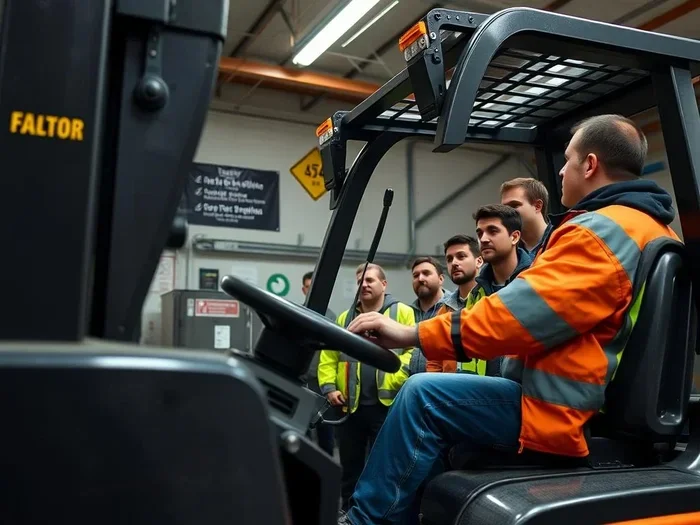
Sit in the operator seat and fasten your seatbelt. Insert the key and start the engine. Listen for any unusual sounds. Check your gauges to make sure the engine is running normally. Adjust your seat, mirrors, and steering wheel for a comfortable and clear view of your path.
Step 2: Check Your Surroundings
Before you move, look in all directions. Check for pedestrians, other vehicles, obstacles, and uneven ground. Forklift blind spots can be significant, especially with a raised load. Use your mirrors and turn your head to check blind spots before moving. Always honk your horn at intersections and blind corners.
Step 3: Release the Parking Brake
Most forklifts have a parking brake. Make sure it is engaged while you are doing your checks. When you are ready to move, release the parking brake. Some forklifts release the parking brake automatically when you press the brake pedal and shift into gear.
Step 4: Shift into Gear
Move the gear shift into the forward or reverse position. Keep your foot on the brake pedal while shifting. Once you are in gear, slowly release the brake and gently press the accelerator. Start slow. You do not need to go fast.
Step 5: Drive at a Safe Speed
Forklift speed limits vary by workplace, but the general rule is to keep it slow. Most forklifts should not exceed 8 kilometers per hour indoors and 15 kilometers per hour outdoors. When there are pedestrians, slow down even more. Remember, a forklift weighs several tons and takes longer to stop than a car.
Use the inch pedal when you need precision. This is especially important when approaching a loading dock, a rack, or a narrow aisle. Smooth, gradual movements prevent loads from shifting and keep you in control.
Step 6: Make Turns Carefully
Because of rear-wheel steering, turns require extra caution. Slow down before the turn, not during it. Turn the steering wheel smoothly and watch the rear end swing out. Always check for pedestrians and obstacles on the side you are swinging toward.
One of the best warehouse forklift tips is to always assume someone is behind you or in your path. The horn is your best friend. Use it generously at intersections, doorways, and when backing up.
Step 7: Park the Forklift Properly
When you are done, parking the forklift correctly matters. Lower the forks completely to the ground. Engage the parking brake. Shift the gear into neutral. Turn off the engine. Remove the key and take it with you. Never leave a running forklift unattended.
Proper forklift parking procedures are part of every safety protocol. A forklift left in gear or with the forks raised is a hazard. Always follow the correct shutdown sequence.
Common Mistakes Beginners Make
Every beginner makes mistakes when learning how to drive a forklift. The key is to learn from them before they cause an accident. Here are the most common errors new operators make.
Driving with the Load Too High
This is perhaps the most dangerous mistake. When the forks are raised high, the forklift becomes top-heavy and unstable. Always keep the load as low as possible when driving, ideally about 15 to 20 centimeters above the ground. Only raise the forks when you are at the exact spot where you need to place the load.
Turning Too Fast
Speed and turns are a bad combination for forklifts. A fast turn can shift the center of gravity outside the stability triangle and cause a tip-over. Always slow down before turning and make smooth, gradual movements.
Ignoring the Load Capacity
Every forklift has a rated load capacity listed on the data plate. Exceeding this capacity is extremely dangerous. Even if the forklift seems fine with a slightly heavy load, you are risking a tip-over or a dropped load. Always check the weight of your load before lifting it.
Skipping the Pre-Operation Check
Some beginners think the pre-operation check is a waste of time. It is not. This inspection catches problems before they become serious. A small leak today can become a major failure tomorrow. Make the checklist a habit.
Not Watching for Pedestrians
Forklifts are loud, heavy, and not always easy to see around. Pedestrians in warehouses may not always hear or see you coming. Always slow down near foot traffic, use your horn, and make eye contact with nearby workers whenever possible.
Tips for Safe and Efficient Forklift Operation
Once you understand the basics, you can start refining your skills. Here are some expert tips that experienced operators swear by.
Keep Your View Clear
When carrying a load, drive in reverse if the load blocks your forward view. This is one of the most important forklift maneuvering techniques. If you cannot see where you are going, you should not be moving. Use a spotter whenever possible in tight or crowded areas.
Maintain Your Forklift
Regular maintenance keeps your forklift running smoothly and safely. Check tire pressure, hydraulic fluid, and brake function weekly. Report any issues to your supervisor immediately. A well-maintained forklift is a safe forklift.
Get Proper Training and Certification
Forklift certification is not optional in most countries. It is a legal requirement. Proper training teaches you not just how to operate the machine, but how to recognize hazards and respond to emergencies. Never operate a forklift without proper certification and training.
Use the Horn Liberally
The horn is your communication tool. Use it at blind corners, doorways, intersections, and when backing up. It alerts pedestrians and other operators to your presence. A simple honk can prevent a serious accident.
Respect the Machine
A forklift is not a regular vehicle. It handles differently, it weighs more, and it demands more respect. Treat it with care, follow all safety protocols, and never take shortcuts. When in doubt, slow down and reassess the situation.
Keep a Clean and Organized Workspace
A cluttered warehouse floor is a hazard. Keep aisles clear of debris, spills, and obstructions. Good housekeeping reduces the risk of accidents and makes forklift operation smoother for everyone. This is one of those warehouse forklift tips that is often overlooked but makes a huge difference.
Conclusion
Learning how to move a forklift for beginners is a journey that starts with knowledge and ends with practice. You now understand the basics of forklift controls, pre-operation checks, safe driving techniques, and common mistakes to avoid. The key to success is patience and consistency. Every time you operate a forklift, apply what you have learned here.
Forklift safety tips are not just rules. They are habits that protect your life and the lives of those around you. Never skip a pre-operation check, always respect the load capacity, and keep your speed under control. With proper training and a commitment to safety, you will become a confident and capable forklift operator.
Remember, every expert was once a beginner. Take it one step at a time, ask questions, and never stop learning. The forklift is a valuable tool, and when you know how to use it correctly, it makes your work easier, faster, and safer.
Frequently Asked Questions
Do I need certification to operate a forklift?
Yes, in most countries, forklift certification is required by law. You must complete a recognized training program that includes both classroom instruction and hands-on practice. Certification ensures you understand safety rules and can operate the machine properly.
Can I drive a forklift on public roads?
Generally, no. Forklifts are designed for indoor or private property use. Driving them on public roads is usually not permitted unless the forklift is specifically equipped with road-safe features like lights, mirrors, and indicators. Always check local regulations before taking a forklift onto any public road.
What should I do if the forklift starts to tip over?
Stay in your seat. Do not jump out. Grip the steering wheel tightly, lean away from the direction of the tip-over, and brace your feet. Jumping from a tipping forklift is one of the leading causes of fatal forklift accidents.
How often should I inspect my forklift?
You should perform a pre-operation inspection every single time before you use the forklift. Additionally, regular detailed maintenance checks should be done weekly or monthly depending on usage and manufacturer recommendations.
Is it harder to drive a forklift than a car?
It feels different, not necessarily harder. The biggest adjustment is rear-wheel steering and the fact that the forklift is much heavier and slower. With practice and proper training, most people become comfortable operating a forklift within a few days.
What is the load center and why does it matter?
The load center is the distance from the front face of the forks to the center of gravity of the load. It matters because it affects the forklift’s stability and rated capacity. A load that is longer or heavier than expected can shift the center of gravity and increase the risk of a tip-over. Always check the load center before lifting.