How Do I Know How Much Weight My Truck Can Carry Now
Knowing how much weight your truck can carry is essential for safety, performance, and avoiding costly fines. Your truck’s payload capacity depends on its GVWR, curb weight, and axle ratings. This guide walks you through every step to calculate and understand your truck’s limits quickly and easily.
If you have ever stared at a pile of lumber, a loaded trailer, or a full bed of gravel and wondered, “Can my truck handle this?” — you are not alone. Truck owners face this question every single day. And the answer matters more than most people realize.
Overloading a truck is not just a ticket waiting to happen. It is a genuine safety hazard. It wears out your brakes faster, strains your suspension, and can cause blowouts on the highway. On the other hand, running too light means you are leaving money and capability on the table. So let us figure out exactly how much weight your truck can carry.
By the time you finish reading this guide, you will know your truck’s payload capacity, how to find your GVWR, and the simple math that takes all the guesswork out of hauling. No guesswork. No stress. Just clear, practical steps you can use today.
Key Takeaways
- GVWR is the foundation: It tells you the maximum total weight your truck can safely handle, including itself and everything inside.
- Payload capacity is what you actually care about: Subtract your truck’s curb weight from the GVWR to find your true hauling number.
- Check multiple sources: Your door jamb sticker, owner’s manual, and payload tag all provide official weight ratings.
- Don’t forget tongue weight and axle limits: Even if your total payload is fine, individual axles can be overloaded.
- Modifications change your numbers: Adding a bed liner, tonneau cover, or upgraded suspension affects how much you can carry.
- Weigh your truck for accuracy: A quick visit to a truck scale gives you real-world numbers that beat estimates every time.
- Overloading is dangerous and illegal: It damages your brakes, suspension, and tires while risking serious accidents.
📑 Table of Contents
- Understanding Your Truck’s Weight Ratings
- Where to Find Your Truck’s Official Weight Limits
- How to Calculate Your Truck’s Actual Carrying Capacity
- Common Mistakes That Lead to Overloading
- How Truck Suspension and Brakes Handle Weight
- Quick Tips for Safe and Smart Hauling
- Expert Insight: Why Payload Awareness Matters
- Key Takeaways
- Conclusion
Understanding Your Truck’s Weight Ratings
Every truck comes with a set of official weight ratings. These numbers are not suggestions. They are engineering limits set by the manufacturer based on the frame, brakes, suspension, and tires. Ignoring them can lead to mechanical failure or worse.
The most important number to know is your Gross Vehicle Weight Rating, commonly called GVWR. This is the maximum total weight of your truck when fully loaded. It includes the weight of the truck itself plus everything inside and behind it.
What Is GVWR?
Your GVWR is printed on a sticker inside the driver’s door jamb. You will also find it in your owner’s manual. This number represents the absolute maximum weight your truck is designed to handle safely. It covers the vehicle, passengers, cargo, fuel, and any trailer tongue weight.
For example, if your truck has a GVWR of 7,000 pounds and the truck itself weighs 4,500 pounds, your available payload capacity is roughly 2,500 pounds. That includes you, your passengers, all your gear, and anything in the bed.
What Is Curb Weight?
Curb weight is the weight of your truck with no passengers or cargo. It includes a full tank of fuel and all standard equipment. This is your starting point for any cargo weight calculation. The lower your curb weight, the more payload you have available.
What Is Payload Capacity?
Payload capacity is the amount of weight you can safely add to your truck. It is the difference between your GVWR and your curb weight. This is the number that matters most when you are planning a haul.
Here is the simple formula:
- Payload Capacity = GVWR – Curb Weight
That is it. Everything else builds on this basic math. Once you know your payload number, you can plan your loads with confidence.
Where to Find Your Truck’s Official Weight Limits
You do not need to guess or estimate. Your truck already has the information built right into it. You just need to know where to look.
Check the Door Jamb Sticker
Open your driver’s door and look for a sticker or plate on the door frame. This is called the vehicle information placard. It lists your GVWR, gross axle weight rating, and tire pressure requirements. This is the single most reliable source for your truck’s weight limits.
Read the Owner’s Manual
Your owner’s manual has a section dedicated to truck specifications. It breaks down payload limits, towing capacity, and axle weight ratings in clear detail. Keep a copy in your glove box for quick reference.
Look for the Payload Tag
Many trucks have a payload tag mounted in the cab or on the frame. This tag shows the maximum cargo weight for the specific model and configuration. It is especially useful if you have added aftermarket accessories that change your truck’s weight.
Use Online Resources
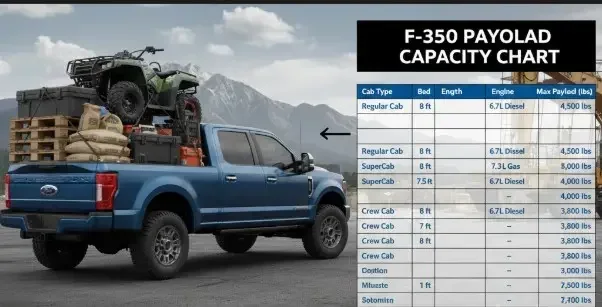
Manufacturers publish payload charts on their websites. You can enter your truck’s year, make, model, and trim to get the exact numbers. This is a great way to double-check what the sticker says.
How to Calculate Your Truck’s Actual Carrying Capacity
Now that you know where to find the numbers, let us put them to work. Calculating your truck’s carrying capacity is straightforward once you understand the pieces.
Step-by-Step Payload Calculation
Follow these steps to determine exactly how much weight your truck can carry:
- Find your GVWR on the door jamb sticker or owner’s manual.
- Weigh your truck empty at a truck scale. This gives you the real curb weight, not just the estimate.
- Subtract the curb weight from the GVWR. The result is your payload capacity.
- Subtract the weight of passengers and gear you always carry. This gives you the available cargo space.
Let us say your GVWR is 7,200 pounds. Your truck weighs 4,600 pounds on the scale. That leaves you 2,600 pounds of payload. If you and a passenger weigh 350 pounds combined, and your toolbox weighs 80 pounds, you have about 2,170 pounds left for cargo in the bed and trailer.
Understanding Axle Weight Limits
Here is something many truck owners overlook. Your total payload might be within limits, but your axles could still be overloaded. Each axle has its own gross axle weight rating, or GAWR. The front axle and rear axle each have separate limits.
If you load heavy cargo all the way in the back of your bed, you might exceed the rear axle limit while staying under the GVWR. This is why checking individual axle weights matters so much.
The Role of Tongue Weight
If you tow a trailer, tongue weight counts toward your truck’s payload. Tongue weight is the downward force the trailer hitch puts on your truck’s rear axle. The general rule is that tongue weight should be about 10 to 15 percent of your total trailer weight.
Too much tongue weight pushes the rear down and lifts the front. Too little tongue weight can cause the trailer to sway. Either extreme is dangerous and throws off your weight distribution.
Common Mistakes That Lead to Overloading
Even experienced truck owners make mistakes when estimating weight. Knowing the common pitfalls helps you avoid them.
Guessing Instead of Weighing
Most people have no idea how much their cargo actually weighs. A cubic yard of gravel can weigh over 3,000 pounds. A full cord of firewood can exceed 4,000 pounds. Guessing leads to overloading more often than you would think.
The fix is simple. Stop by a truck scale before a big load. Many scales charge just a few dollars. That small cost can save you from a serious problem.
Forgetting About Aftermarket Additions
Every addition to your truck adds weight. A tonneau cover adds 40 to 80 pounds. A bed liner can add 100 pounds or more. Upgraded wheels, larger tires, and auxiliary fuel tanks all count. These additions reduce your available payload envelope even if you do not notice them.
Ignoring Passenger and Gear Weight
It is easy to focus on cargo and forget about the people and gear in the cab. Four adults can weigh 600 pounds or more. Luggage, coolers, camping gear, and tools all add up fast. Always account for everything that goes into the truck.
Mixing Up Towing Capacity with Payload
This is the big one. Towing capacity and payload capacity are two completely different numbers. Towing capacity is how much weight your truck can pull behind it. Payload capacity is how much weight you can put inside and on top of it. Confusing the two can lead to dangerous overloading.
How Truck Suspension and Brakes Handle Weight
Your truck’s suspension and braking systems are engineered for specific weight ranges. Exceeding those ranges affects how the truck drives, stops, and handles.
Suspension Limits and Ride Quality
Overloaded trucks sag in the rear. This changes the headlight angle and reduces ground clearance. The suspension components — springs, shocks, and bushings — wear out much faster under excess weight. In severe cases, the suspension can bottom out, causing damage to the frame and undercarriage.
If you regularly carry heavy loads, consider upgrading to heavy-duty springs or adding a weight distribution hitch. These changes help your truck handle weight more safely and comfortably.
Braking Performance Under Load
More weight means more momentum. Your brakes have to work harder to stop a heavier truck. Overloaded trucks take longer to stop, especially in wet or icy conditions. The added stress also causes brake fade on long downhill drives, which is extremely dangerous.
Always make sure your brake system is in top condition when hauling heavy loads. Check your brake pads and fluid regularly. Consider upgrading to performance brakes if you haul frequently.
Tire Pressure and Load Ratings
Your tires are rated for specific weight loads. Check the sidewall for the maximum load rating. Underinflated tires on an overloaded truck overheat and can fail. Always inflate your tires to the pressure recommended for your load weight, not just the pressure listed on the tire itself.
Quick Tips for Safe and Smart Hauling
Here are practical tips that make hauling easier, safer, and more efficient:
- Weigh your truck fully loaded at least once a year to confirm your calculations.
- Distribute weight evenly side to side to prevent the truck from pulling to one direction.
- Place heavier items over the axles to keep the load balanced and improve stability.
- Use a payload scale or bathroom scale for individual items when you cannot access a truck scale.
- Check your tire pressure before every haul, especially when carrying near your maximum capacity.
- Install a weight distribution system if you regularly tow trailers near your truck’s limits.
- Keep a log of your loads so you build a personal reference for future hauls.
Expert Insight: Why Payload Awareness Matters
Experienced truck owners and mechanics will tell you the same thing: payload awareness is the single most overlooked aspect of truck ownership. Many drivers buy a truck for its hauling ability and never once check the actual numbers.
Overloading does not just risk a ticket. It accelerates wear on every major system in your truck. Your transmission, drivetrain, and frame all feel the extra stress. Over time, this leads to premature repairs and reduced truck life.
The best approach is simple. Know your numbers. Weigh your loads. Plan ahead. A few minutes of preparation saves hours of trouble — and potentially prevents a dangerous situation on the road.
Key Takeaways
- GVWR is the foundation: It tells you the maximum total weight your truck can safely handle, including itself and everything inside.
- Payload capacity is what you actually care about: Subtract your truck’s curb weight from the GVWR to find your true hauling number.
- Check multiple sources: Your door jamb sticker, owner’s manual, and payload tag all provide official weight ratings.
- Do not forget tongue weight and axle limits: Even if your total payload is fine, individual axles can be overloaded.
- Modifications change your numbers: Adding a bed liner, tonneau cover, or upgraded suspension affects how much you can carry.
- Weigh your truck for accuracy: A quick visit to a truck scale gives you real-world numbers that beat estimates every time.
- Overloading is dangerous and illegal: It damages your brakes, suspension, and tires while risking serious accidents.
Conclusion
Figuring out how much weight your truck can carry does not have to be complicated. The information is already on your truck. You just need to know where to look and how to do the math. Once you understand your GVWR, curb weight, and payload capacity, you can plan every load with confidence.
Remember that payload capacity, towing capacity, and axle weight limits are all different numbers that serve different purposes. Respect each one. Weigh your cargo when in doubt. And never assume your truck can handle more than its ratings allow.
Taking a few extra minutes to calculate and verify your truck’s limits protects you, your cargo, and everyone else on the road. It also keeps your truck running strong for years to come. Now that you know the steps, you can haul smarter and safer every single time.
So the next time you see a big load waiting for you, you will know exactly whether your truck is up to the task. No guesswork. No stress. Just the facts and the confidence to act on them.
Frequently Asked Questions
What happens if I overload my truck?
Overloading strains your brakes, suspension, and tires. It increases stopping distances and raises the risk of accidents. You can also receive a citation and fine for exceeding weight limits on public roads.
How do I find my truck’s payload capacity?
Locate your GVWR on the door jamb sticker or owner’s manual. Then weigh your empty truck on a scale. Subtract the curb weight from the GVWR to get your payload capacity in pounds.
Does tongue weight count toward payload?
Yes, tongue weight from a trailer counts toward your truck’s total payload. It is the downward force on the hitch and rear axle. Keep tongue weight between 10 and 15 percent of your trailer’s total weight for safe towing.
Can I increase my truck’s payload capacity?
You cannot exceed the manufacturer’s GVWR. However, you can optimize your payload by removing unnecessary weight, upgrading suspension components, and ensuring your tires are rated for the load you carry.
What is the difference between towing capacity and payload capacity?
Towing capacity is how much weight your truck can pull behind it on a trailer. Payload capacity is how much weight you can put inside and on the truck itself. They are separate numbers based on different engineering limits.
Should I weigh my truck after loading?
Absolutely. Weighing your fully loaded truck at a truck scale confirms your calculations and ensures you are within safe limits. It is one of the best habits any truck owner can develop for safe and legal hauling.