How to Read a 17 Digit VIN Number and Decode Your Car
Learning how to read a 17 digit VIN number is easier than you think. Each character in your VIN reveals important car details like the manufacturer, model year, engine type, and assembly plant. This guide walks you through every section step by step so you can decode your vehicle with confidence.
Have you ever looked at the long string of letters and numbers on your car and wondered what it all means? That code is your VIN number, and it holds a treasure trove of information about your vehicle. Every car manufactured since 1981 has a 17 digit VIN that acts like a unique fingerprint. No two vehicles on the road share the same one.
So how do you read a 17 digit VIN number? It might look like a random jumble of characters at first glance. But once you know the system, each section tells you something specific. You can learn the country of origin, the manufacturer, the engine type, the model year, and even the assembly plant. It is actually pretty fascinating once you break it down.
This guide will walk you through every single character. You will learn where to find your VIN, what each section means, and how to use a VIN decoder tool to get full car details. Whether you are buying a used car, doing research, or just curious, this article has you covered. Let us dive in and decode your vehicle together.
Key Takeaways
- Every VIN is unique: No two vehicles share the same 17 character code, making it your car’s fingerprint.
- The VIN has three main sections: The WMI, VDS, and VIS each tell you different things about the vehicle.
- You can find your VIN in several places: Check the dashboard, driver side door jamb, or registration documents.
- A VIN decoder tool saves time: These tools instantly pull car details and history reports for free or low cost.
- Common mistakes cause errors: Confusing similar letters and numbers is the top mistake people make when decoding a VIN.
- The 10th character shows the model year: This is one of the most useful and easy to find pieces of information.
- Always verify the check digit: It helps confirm the VIN is valid and not tampered with.
📑 Table of Contents
- What Is a VIN Number and Why It Matters
- Where to Find Your VIN Number on Your Car
- How to Read a 17 Digit VIN Number: Breaking Down Each Section
- Using a VIN Decoder Tool to Get Full Vehicle Details
- Common Mistakes People Make When Decoding a VIN Number
- Final Thoughts on How to Read a 17 Digit VIN Number
What Is a VIN Number and Why It Matters
What Does VIN Stand For?
VIN stands for Vehicle Identification Number. It is a standardized code assigned to every motor vehicle. The International Organization for Standardization (ISO) set the rules for this system in 1981. Before that, different manufacturers used different formats, which caused confusion.
The 17 digit VIN format gives every car a unique identity. Think of it like a social security number for your vehicle. It tracks everything from recalls to ownership history. When you check VIN online, you can pull up a full vehicle history report in seconds.
Why Your VIN Number Is So Important
Your VIN number matters for many reasons. Here are the key ones:
- Identification: It tells police, insurance companies, and dealerships exactly which vehicle you own.
- Recalls: Manufacturers use the VIN to notify owners about safety recalls and fixes.
- History Reports: A VIN lookup reveals past accidents, title issues, and service records.
- Registration: You need the VIN to register your car and get license plates.
- Insurance: Insurance companies use the VIN to verify the vehicle and set rates.
- Parts Matching: Mechanics use the VIN to find the correct parts for your specific car.
Understanding your VIN number gives you power. You can verify a car’s history before buying. You can check for open recalls. You can even confirm the trim level and factory safety features. It is one of the most valuable tools a car owner can have.
Where to Find Your VIN Number on Your Car
Finding your VIN is the first step in learning how to read a 17 digit VIN number. The good news is that VINs are displayed in multiple places on every vehicle. Here are the most common spots to look.
Common VIN Locations
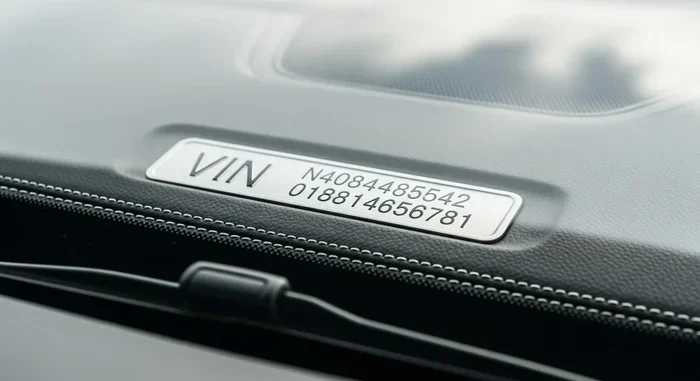
- Dashboard: Stand outside the driver side door and look at the corner of the dashboard where it meets the windshield. The VIN is usually stamped on a metal plate or printed on a sticker.
- Driver Side Door Jamb: Open the driver door and look for a sticker on the door frame. This sticker often includes the VIN along with tire pressure information.
- Engine Block: Pop the hood and look for the VIN stamped directly on the engine block. This is especially useful for verifying the engine matches the records.
- Rear Wheel Well: Some vehicles stamp the VIN on the body near the rear wheel. Check the frame or body panel in that area.
- Vehicle Title and Registration: Your VIN will be printed on your car title and registration documents.
- Insurance Card: Your auto insurance card lists the VIN for quick identification.
What If the VIN Is Hard to Find?
Sometimes the VIN sticker fades or gets damaged over time. If you cannot find it on the car itself, check your paperwork. The vehicle title, registration, and insurance documents all list the VIN. You can also check the owner manual or contact the dealership with your license plate number. They can look up the VIN for you.
Quick Tip: Always take a photo of your VIN and save it in your phone. You never know when you will need it quickly. This simple habit saves a lot of time and hassle.
How to Read a 17 Digit VIN Number: Breaking Down Each Section
Now comes the fun part. The 17 digit VIN is divided into three main sections. Each section serves a specific purpose. Let us break them down one by one.
The First Three Characters: World Manufacturer Identifier
The first three characters form the World Manufacturer Identifier, or WMI. This section identifies who made the vehicle and where it was built.
- Character 1: Identifies the country of origin. For example, 1, 4, or 5 means the car was made in the United States. J means Japan, W means Germany, and so on.
- Character 2: Identifies the manufacturer. Each automaker gets a specific letter or number code. For instance, G stands for General Motors, T for Toyota, and F for Ford.
- Character 3: Identifies the manufacturer division or vehicle type. This tells you if it is a specific brand line or vehicle category.
Together, these three characters give you the manufacturer code. They tell you the basics of who built the car and where. This is the foundation of the entire VIN system.
Characters 4 Through 8: Vehicle Descriptor Section
Characters 4 through 8 make up the Vehicle Descriptor Section, or VDS. This is where things get detailed. These five characters describe the vehicle itself.
What you can learn from this section includes:
- Model line: The specific model of the vehicle.
- Body style: Sedan, SUV, truck, coupe, and so on.
- Engine type: The size and type of engine installed.
- Transmission: Whether it has automatic or manual transmission.
- Trim level: The specific trim package and features.
Each manufacturer uses these characters slightly differently. Some brands use the VDS to describe safety features and restraint systems. Others focus on the engine and drivetrain. The exact meaning varies by automaker, but the section always provides key vehicle specs.
Character 9: The Check Digit
Character 9 is the check digit. It is a mathematical calculation based on all the other characters in the VIN. Its purpose is to detect invalid VINs.
Here is how it works. Every character in the VIN is assigned a numeric value. The position of each character also has a weight. You multiply and add these values together, then divide by 11. The remainder becomes the check digit. If the remainder is 10, the letter X is used instead.
This check digit helps confirm that the VIN is valid and has not been tampered with. If you run a VIN check and the check digit does not match, something is wrong. That is a red flag worth investigating further.
Character 10: Model Year
Character 10 tells you the model year of the vehicle. This is one of the easiest parts of the VIN to decode.
The system uses a rolling alphabet that skips certain letters to avoid confusion. Letters I, O, Q, U, and Z are not used. Here is a quick reference:
- A = 1980
- B = 1981
- C = 1982
- D = 1983
- E = 1984
- F = 1985
- G = 1986
- H = 1987
- J = 1988
- K = 1989
- L = 1990
- M = 1991
- N = 1992
- P = 1993
- R = 1994
- S = 1995
- T = 1996
- V = 1997
- W = 1998
- X = 1999
- Y = 2000
- 1 = 2001
- 2 = 2002
- 3 = 2003
- 4 = 2004
- 5 = 2005
- 6 = 2006
- 7 = 2007
- 8 = 2008
- 9 = 2009
- A = 2010
- B = 2011
- C = 2012
- D = 2013
- E = 2014
- F = 2015
- G = 2016
- H = 2017
- J = 2018
- K = 2019
- L = 2020
- M = 2021
- N = 2022
- P = 2023
- R = 2024
- S = 2025
The pattern repeats every 30 years since the letters I, O, Q, U, and Z are skipped. So the system has plenty of combinations to go around.
Character 11: Assembly Plant
Character 11 identifies the assembly plant where the vehicle was built. Each manufacturer assigns plant codes. For example, a Ford built in Dearborn, Michigan might have a different code than one built in Cuautitlan, Mexico.
This character is useful for verifying where a vehicle was actually assembled. Sometimes buyers assume a car was made in one country, but the plant code tells a different story. It is one of those details that can matter for car history and authenticity checks.
Characters 12 Through 17: Vehicle Identifier Section
The last six characters form the Vehicle Identifier Section, or VIS. This is the serial number portion of the VIN. It identifies the specific vehicle as part of the production sequence.
Each manufacturer uses this section differently. Some use it as a straight sequential number. Others embed additional information like the production order. The key takeaway is that these six characters make your car truly one of a kind.
No other vehicle in the world shares the same combination of all 17 characters. That is the power of the VIN system. It gives every car a completely unique identity.
Using a VIN Decoder Tool to Get Full Vehicle Details
Manually decoding a VIN is a great learning exercise. But in real life, most people use a VIN decoder tool to get quick and accurate results. These tools take your 17 character code and instantly pull up detailed information.
Free vs Paid VIN Decoders
There are two main types of VIN decoder tools available online. Here is how they compare:
| Feature | Free VIN Decoders | Paid VIN Decoders |
|---|---|---|
| Basic vehicle specs | Yes | Yes |
| Model year and manufacturer | Yes | Yes |
| Engine and transmission details | Yes | Yes |
| Full vehicle history report | Limited | Yes |
| Accident and damage history | No | Yes |
| Title and ownership records | No | Yes |
| Recall information | Yes | Yes |
| Odometer readings | No | Yes |
| Cost | Free | Varies ($10-$40) |
Free decoders are great for basic vehicle specs. They can tell you the manufacturer, model year, and engine type. If you want a full car history report, you will likely need a paid service. Popular options include Carfax, AutoCheck, and the free government recall lookup tool.
What Information Can You Get from a VIN Decoder?
A good VIN decoder tool can pull up a surprising amount of information. Here is what you can typically expect:
- Manufacturer and brand
- Model name and trim level
- Model year
- Engine size and type
- Transmission type
- Drive type (front wheel, rear wheel, all wheel)
- Body style
- Country of manufacture
- Assembly plant location
- Safety and restraint features
- Open recalls
- Vehicle history (with paid services)
Using a VIN decoder is one of the smartest things you can do before buying a used car. It takes seconds and can save you from buying a vehicle with hidden problems. Always run a VIN check before making a purchase decision.
Common Mistakes People Make When Decoding a VIN Number
Even with the best intentions, people make mistakes when trying to decode a VIN. Here are the most common ones to avoid.
Confusing Similar Letters and Numbers
This is the number one mistake. The letters I, O, and Q are never used in a VIN to avoid confusion with the numbers 1 and 0. If you see an I in a VIN, it might actually be the number 1. The same goes for O and 0. Always double check your transcription to make sure you have the right characters.
Assuming All Sections Mean the Same Thing Across Brands
Different manufacturers use the VDS (characters 4 through 8) differently. What means one thing for Ford might mean something different for Honda. Always refer to the specific manufacturer’s VIN format when doing detailed decoding.
Ignoring the Check Digit
Many people skip the check digit entirely. But this is a valuable verification tool. If the check digit does not match the rest of the VIN, it could mean the VIN has been altered or is fake. Never ignore this character.
Forgetting the Model Year Cycle
The VIN model year system cycles every 30 years. A VIN starting with B could be 1981 or 2011. Always consider the context. If the car looks modern, a B in the 10th position likely means 2011, not 1981.
Not Verifying with a Second Source
Always cross check your decoded VIN with the vehicle’s documentation. The title, registration, and insurance card should all match. If anything does not align, dig deeper before proceeding.
Expert Insight: “The check digit and model year are the two most overlooked parts of a VIN. Together, they can reveal whether a VIN is legitimate or potentially fraudulent. Always verify both when doing a VIN check.” Automotive Industry Specialist
Final Thoughts on How to Read a 17 Digit VIN Number
Learning how to read a 17 digit VIN number opens up a world of knowledge about any vehicle. You no longer have to guess where a car was made, what engine it has, or what year it is. Every character tells a story, and now you know how to read it.
Start by finding your VIN in one of the common locations we discussed. Then break it down section by section. Use the WMI to identify the manufacturer and country. Check the VDS for vehicle specs like engine type and trim level. Look at the model year character and assembly plant code. And remember the check digit to verify authenticity.
If you want even deeper details, run your VIN through a decoder tool. You will get a full vehicle history report, recall information, and specs in seconds. It is an incredibly powerful tool for any car owner or buyer.
The next time you see that long string of characters on your car, you will know exactly what it means. Your VIN is more than just a number. It is the complete story of your vehicle. Take the time to understand it. It is one of the best investments of knowledge you can make as a car owner.
So go ahead. Look up your VIN. Decode it. And discover the hidden details your car has been sharing with you all along.
Frequently Asked Questions
Can a VIN number be less than 17 digits?
Vehicles manufactured before 1981 may have VINs shorter than 17 characters. The standardized 17 digit format was introduced in 1981. If your car was made before that year, the VIN format may vary by manufacturer and will not follow the same breakdown described in this guide.
What does the 10th character in a VIN mean?
The 10th character represents the model year of the vehicle. It uses a rolling alphabet system that skips the letters I, O, Q, U, and Z. This character is one of the easiest and most useful parts of the VIN to decode.
Is a VIN decoder free to use?
Many basic VIN decoders are free online. They can tell you the manufacturer, model year, engine type, and other specs. For a full vehicle history report with accident records and title information, you may need to use a paid service like Carfax or AutoCheck.
Can two cars have the same VIN?
No. Every VIN is unique to a single vehicle. No two cars manufactured share the same 17 character code. If you find two vehicles with identical VINs, it is a serious red flag indicating possible fraud or tampering.
What if my VIN number has letters I and O?
The letters I and O are intentionally excluded from VINs to avoid confusion with the numbers 1 and 0. If you see an I or O in a VIN, it is likely a transcription error. Always double check the VIN against the vehicle’s sticker or plate to ensure accuracy.
Where can I get a free car history report?
You can get a free vehicle history report through the National Insurance Crime Bureau (NICB) or the government’s recall lookup tool. Many dealerships and auto websites also offer limited free VIN checks. For comprehensive reports, paid services like Carfax and AutoCheck provide the most detailed information.