Can You Put a Tow Hitch on a Toyota Corolla Easily
Yes, you can put a tow hitch on a Toyota Corolla. Most Corolla models from 2014 onward support a Class I trailer hitch with a towing capacity of up to 1,500 pounds. This guide covers everything you need to know about tow hitch installation, compatible hitch types, towing safety, and the accessories that make towing with a Corolla simple and safe.
So you own a Toyota Corolla and you want to tow something. Maybe it is a small camping trailer, a bike rack, or a utility cart for work. The question on your mind is simple: can you put a tow hitch on a Toyota Corolla? The short answer is yes. But the full answer has some important details you need to know before you start shopping for towing equipment.
The Toyota Corolla is one of the most popular sedans on the road. It is reliable, fuel-efficient, and affordable. But when it comes to towing, many people assume it cannot handle the job. That is not true. With the right trailer hitch and the right setup, your Corolla can tow safely and effectively. This guide walks you through everything you need to know.
We will cover towing capacity, hitch types, installation steps, safety tips, and common mistakes. Whether you own a 2014 Corolla or a 2024 model, you will find practical advice here. Let us get into it.
Key Takeaways
- Yes, it is possible: Most Toyota Corolla models can support a tow hitch, especially newer trims from 2014 and up.
- Class I hitches work best: These lightweight hitches handle up to 1,500 pounds and are ideal for small trailers and bikes.
- Check your trim level: Not every Corolla trim comes with a factory towing package, so verify before buying.
- Installation is manageable: With basic tools and a guide, most DIYers can install a hitch in under two hours.
- Safety comes first: Always use proper wiring, weight distribution, and towing accessories for safe towing.
- Avoid common mistakes: Overloading, skipping wiring, and ignoring local towing laws are the top errors drivers make.
📑 Table of Contents
- Can You Put a Tow Hitch on a Toyota Corolla?
- Understanding Your Toyota Corolla Towing Capacity
- Types of Tow Hitches That Fit a Toyota Corolla
- Step-by-Step Hitch Installation Guide
- Towing Accessories and Safety Essentials
- Common Mistakes When Installing a Corolla Hitch
- Is Towing with a Toyota Corolla Worth It?
Can You Put a Tow Hitch on a Toyota Corolla?
The answer depends on your model year and trim level. Most Toyota Corolla models from 2014 onward are compatible with a Class I trailer hitch. These hitches are designed for light-duty towing. They bolt onto the rear bumper or frame and provide a secure connection point for a ball mount or receiver hitch.
Older Corolla models, such as those from 2009 to 2013, can also accept a tow hitch. However, you need to check the specific towing capacity for your year and trim. Some older models have lower payload limits, which means you need to be more careful about how much weight you tow.
Here is what you should know about Corolla towing compatibility:
- 2014–2019 Corolla: Most trims support a Class I hitch. Towing capacity ranges from 1,000 to 1,500 pounds depending on the engine.
- 2020–2024 Corolla: Newer models with the 2.0-liter engine can tow up to 1,500 pounds with the proper hitch setup.
- Corolla Hybrid: Hybrid models also support towing, but always check the owner manual for specific limits.
- Older models (pre-2014): Compatibility varies. Some trims need a custom mounting bracket.
The key is to look up your specific Corolla trim level and confirm the factory towing specifications. Toyota provides these numbers in every owner manual. You can also check with a dealer or an online towing guide for your exact model.
Why Towing Capacity Matters
Every vehicle has a maximum towing capacity. This is the total weight your car can safely pull behind it. Exceeding this limit can damage your engine, transmission, and brakes. It can also create dangerous driving conditions.
For the Toyota Corolla, the towing capacity is relatively modest compared to trucks or SUVs. But for its intended purpose, it is more than enough. A Class I hitch on a Corolla can handle small utility trailers, kayak carriers, bike racks, and lightweight camping gear.
Think about what you plan to tow. If you are pulling a small trailer with camping supplies, a Corolla will handle it easily. If you are trying to tow a large boat or a heavy equipment trailer, you need a bigger vehicle. Always stay within the rated payload capacity of your car.
Understanding Your Toyota Corolla Towing Capacity
Before you buy any towing equipment, you need to understand your Corolla’s limits. Towing capacity is not just about the hitch. It involves the engine, transmission, brakes, suspension, and frame. Toyota engineers all of these systems to work together within specific weight limits.
Here is a quick breakdown of what affects towing capacity on a Corolla:
- Engine size: The 1.8-liter engine in older models has a lower towing limit than the 2.0-liter engine in newer models.
- Transmission type: Both automatic and manual transmissions can tow, but automatic models often handle towing better for long trips.
- Rear suspension: The Corolla uses a torsion beam rear suspension, which is adequate for light towing but not for heavy loads.
- Brake system: Your brakes need to stop both the car and the trailer. Heavier loads require more braking power.
- Gross Vehicle Weight Rating (GVWR): This is the maximum weight your car can carry, including passengers, cargo, and trailer tongue weight.
The towing capacity for most Corolla models falls between 1,000 and 1,500 pounds. This is known as light-duty towing. It is perfect for recreational trailers, small utility trailers, and cargo carriers. If you need to tow heavier loads, a different vehicle is the right choice.
What Is the Difference Between Towing Capacity and Payload Capacity?
These two terms are often confused, but they mean different things. Towing capacity is how much weight your car can pull behind it on a trailer. Payload capacity is how much weight your car can carry inside it, including passengers, cargo, and the tongue weight of the trailer.
For example, if your Corolla has a payload capacity of 850 pounds and you load four people at 150 pounds each, that is 600 pounds. You only have 250 pounds left for cargo and trailer tongue weight. Understanding this difference helps you stay safe and avoid overloading your vehicle.
Types of Tow Hitches That Fit a Toyota Corolla
Not all hitches are the same. Different types serve different purposes. When choosing a trailer hitch for your Corolla, you have several options. Let us break them down.
Class I Trailer Hitch
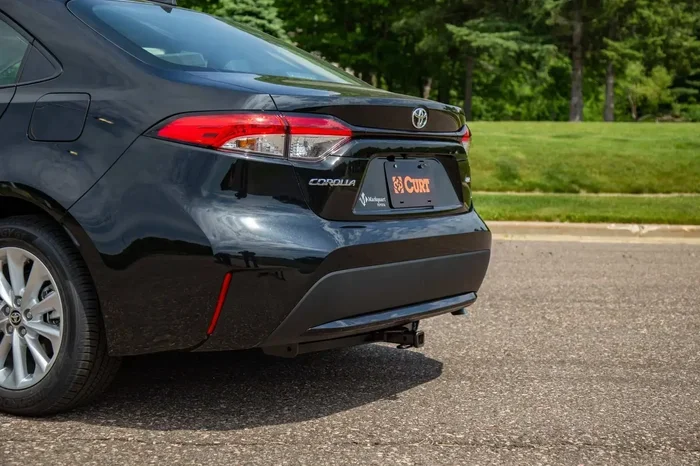
The Class I hitch is the most common choice for a Toyota Corolla. It is a lightweight hitch designed for towing up to 1,500 pounds. Most Corolla owners choose this type because it is affordable, easy to install, and handles the most common towing needs.
A Class I hitch works well for:
- Bicycle racks
- Small cargo trailers
- Kayak or canoe carriers
- Light utility trailers
- Motorcycle carriers
These hitches usually have a 1-1/4 inch receiver tube. They bolt onto the rear bumper or frame with four to six bolts. Installation is straightforward and does not require cutting or welding.
Class II Trailer Hitch
A Class II hitch can handle up to 3,500 pounds of towing capacity. It uses a 2-inch receiver tube. Some Corolla owners upgrade to a Class II hitch if they plan to tow slightly heavier loads. However, you need to make sure your Corolla’s frame and suspension can handle the extra weight.
For most Corolla owners, a Class I hitch is the right choice. A Class II may be overkill unless you have specific towing needs. Always check your vehicle’s specifications before choosing a higher-class hitch.
Custom and Aftermarket Hitches
Several aftermarket brands make hitches specifically for the Toyota Corolla. Brands like Curt, Draw-Tite, and Reese offer fit-specific hitches that bolt right onto your car without modification. These hitches come with all the hardware you need and often include wiring harnesses for trailer lights.
When shopping for an aftermarket hitch, look for these features:
- Direct bolt-on installation (no drilling or cutting)
- Included wiring harness for trailer lights
- Weight rating that matches your Corolla’s capacity
- Warranty from the manufacturer
- Corrosion-resistant coating for durability
Step-by-Step Hitch Installation Guide
Installing a tow hitch on a Toyota Corolla is one of the more straightforward hitch installation jobs you can do. You do not need a professional mechanic. With basic tools and about two hours of time, you can complete the job yourself.
What You Will Need
Before you start, gather these tools and materials:
- Class I or Class II trailer hitch (specific to your Corolla model year)
- Socket wrench set (metric sizes)
- Torque wrench
- Jack and jack stands or ramps
- Wire brush (for cleaning bolt holes)
- Anti-seize lubricant
- Trailer wiring harness (if not included with the hitch)
- Owner manual for your specific Corolla year
Installation Steps
Follow these steps for a safe and secure hitch installation:
Step 1: Prepare the Vehicle Park your Corolla on a flat, level surface. Engage the parking brake. If you are working underneath the car, use jack stands for safety. Never rely on a jack alone.
Step 2: Remove the Rear Bumper Trim Most Corolla models require removing the rear bumper cover or trim to access the mounting points. Use a plastic trim tool to carefully pry off the clips. Keep all clips and screws in a safe place.
Step 3: Locate the Mounting Points Look for pre-drilled holes on the rear frame or bumper. Toyota designs most Corolla models with factory mounting points for hitches. Clean these holes with a wire brush to remove rust or debris.
Step 4: Position the Hitch Hold the hitch bracket against the mounting points. Align the bolt holes. Insert the bolts and hand-tighten the nuts. Make sure the hitch is centered and level.
Step 5: Tighten the Bolts Use a torque wrench to tighten all bolts to the manufacturer’s specifications. Do not over-tighten. The correct torque ensures a secure fit without damaging the frame.
Step 6: Install the Receiver Tube and Ball Mount Slide the receiver tube into the hitch bracket. Insert the ball mount into the receiver. Tighten the locking pin or hitch pin to secure everything in place.
Step 7: Connect the Wiring Harness Run the trailer wiring harness from the hitch to the rear of the car. Connect the wires to the factory harness or use a splice connector. Test the trailer lights, brake lights, and turn signals before driving.
Step 8: Test the Installation Before hitting the road, do a test pull. Attach a light trailer and check for stability. Listen for any rattling or clicking sounds. Make sure the hitch is secure and the wiring is not pinched.
Quick Tips for Installation
- Always refer to your Corolla owner manual for specific torque values and mounting instructions.
- Apply anti-seize lubricant to all bolts. This prevents rust and makes future removal easier.
- Take photos during removal. This helps you remember where everything goes during reinstallation.
- If you are unsure about any step, consult a professional mechanic. It is better to be safe than sorry.
Towing Accessories and Safety Essentials
Installing a hitch is only part of the equation. To tow safely with a Toyota Corolla, you need the right towing accessories. These items improve safety, stability, and convenience.
Essential Towing Accessories
- Ball mount: This is the piece that connects the hitch receiver to the trailer. Choose the correct drop length for your trailer height.
- Ball hitch: The ball attaches to the ball mount and connects to the trailer coupler. Make sure the ball size matches your trailer (usually 1-1/4 inch for Class I).
- Trailer wiring harness: This connects your Corolla’s lights to the trailer lights. It includes brake lights, turn signals, and running lights.
- Weight distribution hitch: For loads near your Corolla’s max towing capacity, a weight distribution system helps balance the trailer weight across all axles.
- Trailer brakes: If your trailer is heavy, it may need its own braking system. Check local laws for trailer brake requirements.
- Safety chains: Always cross safety chains under the trailer tongue. They serve as a backup if the hitch fails.
- Mirror extensions: Trailer mirrors give you better visibility behind the trailer. They are essential for safe lane changes and turns.
Towing Safety Best Practices
Towing changes how your car drives. The added weight affects braking, acceleration, and handling. Follow these safety tips every time you tow:
- Check your load before every trip. Make sure the trailer is properly secured and the cargo is balanced.
- Drive slower than normal. Reduce your speed by 10 to 15 mph below the speed limit. This gives you more time to react.
- Leave extra following distance. A trailer adds weight and length. You need more space to stop safely.
- Use lower gears on hills. Downshift when going uphill or downhill. This reduces strain on your brakes and engine.
- Check tire pressure on both the car and the trailer. Underinflated tires are a leading cause of towing accidents.
- Do not exceed your towing capacity. This cannot be stressed enough. Overloading is dangerous and can void your warranty.
Expert Insight: Why Proper Wiring Matters
A professional tow hitch installer once told me that the most overlooked part of towing is the wiring harness. Many people install the hitch and forget about the electrical connection. Without proper wiring, your trailer lights will not work. This is not just inconvenient. It is illegal and dangerous. Always invest in a quality wiring harness and test it before every trip.
Common Mistakes When Installing a Corolla Hitch
Even experienced DIYers make mistakes during hitch installation. Here are the most common errors and how to avoid them.
Mistake 1: Choosing the Wrong Hitch Class
Some owners buy a Class II hitch thinking it gives them more towing power. But if their Corolla cannot support the weight, the hitch is useless. Always match your hitch class to your vehicle’s towing capacity. For most Corollas, a Class I hitch is the right choice.
Mistake 2: Skipping the Wiring Harness
It is tempting to skip the wiring harness, especially if you are only towing a bike rack. But trailer lights are a legal requirement in most states. A wiring harness is inexpensive and easy to install. Do not skip it.
Mistake 3: Over-tightening Bolts
Using a regular wrench and cranking down on bolts can strip the threads or crack the frame. Always use a torque wrench and follow the manufacturer’s specifications. Proper torque ensures a secure fit without causing damage.
Mistake 4: Ignoring Local Towing Laws
Every state and country has different towing regulations. Some require trailer brakes for loads over a certain weight. Others require specific mirrors or safety chains. Check your local laws before towing. Ignorance is not an excuse for a ticket or an accident.
Mistake 5: Forgetting About Weight Distribution
If your trailer tongue weight is too far back, the rear of your Corolla will sag. This affects steering and braking. A weight distribution hitch or proper cargo placement solves this problem. Always distribute weight evenly and keep heavy items low and forward in the trailer.
Is Towing with a Toyota Corolla Worth It?
The Toyota Corolla is not a towing powerhouse. But for many people, it is more than enough. If you need to tow a small trailer, carry bikes, or haul light cargo, a Corolla with a tow hitch is a practical and affordable solution.
The Corolla offers excellent fuel economy, even when towing. Its reliable engine and low maintenance costs make it a smart choice for occasional towing. You do not need a truck or SUV to handle light-duty towing tasks.
Here is a quick comparison of the Corolla’s towing capability against other popular vehicles:
| Vehicle | Max Towing Capacity | Hitch Class | Best For |
|---|---|---|---|
| Toyota Corolla | 1,500 lbs | Class I | Bike racks, small trailers, cargo carriers |
| Toyota RAV4 | 3,500 lbs | Class II | Medium trailers, boats, ATVs |
| Toyota Tacoma | 6,500 lbs | Class III/IV | Heavy trailers, large boats, equipment |
| Honda Civic | 1,500 lbs | Class I | Bike racks, small utility trailers |
| Ford F-150 | 13,500 lbs | Class V | Large trailers, heavy equipment |
As you can see, the Corolla holds its own among compact and mid-size sedans for light towing. It may not match an SUV or truck, but for most everyday towing needs, it is more than capable.
Final Thoughts on Tow Hitch Installation
Putting a tow hitch on a Toyota Corolla is straightforward, affordable, and practical. Whether you need a Class I trailer hitch for a bike rack or a small utility trailer, the right setup makes all the difference. Follow the installation steps carefully, use quality towing accessories, and always stay within your vehicle’s rated capacity. Your Corolla is ready to tow. You just need the right equipment and the right knowledge.
Start by checking your specific model year and trim. Choose a hitch that matches your towing needs. Install it carefully or have a professional do it. Connect your wiring, test everything, and hit the road with confidence. Towing with a Toyota Corolla is not just possible. It is easy, safe, and practical when you do it right.
Remember, the key to successful towing is preparation. Know your limits, use the right equipment, and never compromise on safety. Your Toyota Corolla will serve you well for many towing adventures to come.
Frequently Asked Questions
What is the towing capacity of a Toyota Corolla?
Most Toyota Corolla models from 2014 onward have a towing capacity of 1,000 to 1,500 pounds. The exact number depends on your model year, engine size, and trim level. Always check your owner manual for the specific towing capacity of your vehicle before attaching any trailer.
Can I install a tow hitch on a Toyota Corolla myself?
Yes, installing a tow hitch on a Corolla is a manageable DIY project. Most Class I hitches bolt onto factory mounting points with basic tools. The process takes about two hours and does not require welding or cutting. If you are not comfortable working under the car, a professional mechanic can complete the installation quickly.
Do I need a towing package for my Toyota Corolla?
Not all Corolla trims come with a factory towing package. However, most models from 2014 onward have pre-drilled mounting points that accept aftermarket hitches. A factory towing package may include upgraded wiring, a stronger suspension, and a higher towing capacity. Check your trim specifications to see if your Corolla has the package.
What type of hitch is best for a Toyota Corolla?
A Class I trailer hitch is the best choice for most Corolla owners. It supports up to 1,500 pounds of towing capacity and is the most affordable option. It works well for bike racks, small cargo trailers, and kayak carriers. A Class II hitch is only necessary if you plan to tow heavier loads near the Corolla’s maximum capacity.
Do I need trailer brakes when towing with a Corolla?
Trailer brake requirements vary by state and country. In most places, trailers over 1,500 pounds need their own braking system. Even if your trailer is under that weight, having brakes improves safety and stopping power. Always check your local towing laws and install trailer brakes if required or recommended for your load.
Can a Toyota Corolla Hybrid tow a trailer?
Yes, Toyota Corolla Hybrid models can tow trailers. The towing capacity is similar to the gas-powered Corolla, usually around 1,000 to 1,500 pounds. Always refer to the owner manual for the exact towing specifications of your hybrid model. The electric motor does not change the towing limits significantly.
=== CONCLUSION ===
So, can you put a tow hitch on a Toyota Corolla? The answer is a clear yes. With the right Class I trailer hitch, proper installation, and the correct towing accessories, your Toyota Corolla can handle light-duty towing with confidence. The key is knowing your vehicle’s limits, choosing the right equipment, and following safe towing practices.
Whether you are hauling a small trailer, carrying bikes, or moving light cargo, a tow hitch transforms your Corolla into a versatile vehicle. The installation process is straightforward, the equipment is affordable, and the results are practical. You do not need a truck or SUV for every towing job. Sometimes, a reliable Toyota Corolla with a properly installed hitch is all you need.
Take the time to research your specific model year, invest in quality towing equipment, and always prioritize safety. Your Toyota Corolla is ready to tow. All you need is the right setup and the confidence to get out there and do it.