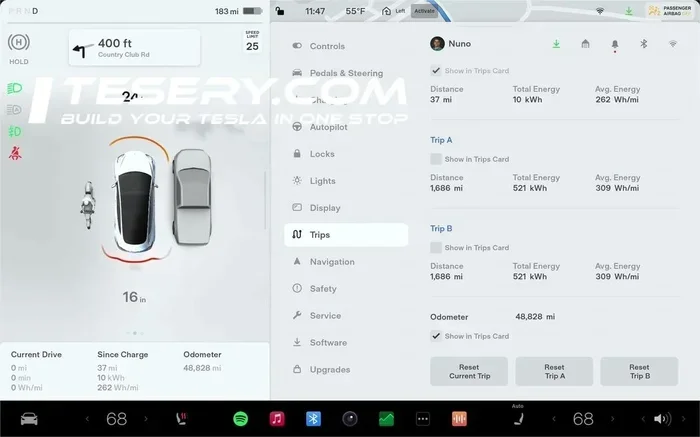
Does Mileage Matter on a Tesla When Buying Used Cars
Does mileage matter on a Tesla when buying used? The short answer is yes, but it matters differently than with gas cars. Tesla electric vehicles have fewer moving parts, so high mileage does not automatically mean a worn-out car. However, battery degradation and range loss are real factors you must check before buying. Understanding EV battery health, charging habits, and Tesla battery lifespan will help you make a smart purchase. This guide covers everything you need to know about mileage on a used Tesla.
When you are shopping for a used Tesla, one of the first things you notice is the number on the odometer. Mileage on a car has always been a big deal. For gas-powered vehicles, high mileage usually means worn-out engines, transmission problems, and expensive repairs. But Tesla electric vehicles work completely differently. The question is simple yet confusing: does mileage matter on a Tesla?
The truth might surprise you. A Tesla with 150,000 miles on the clock can still feel like a brand-new car in many ways. That is because the electric drivetrain has far fewer moving parts than a traditional engine. There is no oil to change, no transmission to rebuild, and no spark plugs to replace. So does that mean mileage does not matter at all? Not exactly. Battery health and range loss are the two things you need to watch closely. This guide breaks down everything you need to know about mileage on a Tesla when buying pre-owned.
Key Takeaways
- Mileage matters less on Teslas: Electric drivetrains have fewer wear parts than gas engines, so high mileage alone is not a dealbreaker.
- Battery health is the real metric: Check the battery’s original capacity and current state of health before trusting any odometer reading.
- Tesla battery degradation is gradual: Most Teslas lose only about 1-2% of range per year under normal use.
- Warranty coverage helps: Tesla’s battery and drive unit warranty still applies to used vehicles, offering peace of mind.
- Charging habits affect longevity: Frequent Supercharging and daily DC fast charging can accelerate battery wear over time.
- Resale value stays strong: Teslas with moderate mileage still hold their value well in the pre-owned market.
- Always get a vehicle history report: A Tesla vehicle history check reveals past accidents, service records, and charging patterns.
📑 Table of Contents
- Why Mileage Works Differently on a Tesla
- Understanding Tesla Battery Degradation
- How to Evaluate Mileage on a Used Tesla
- Tesla Models and Mileage: What to Expect
- Does Mileage Affect Tesla Resale Value?
- Common Mistakes Buyers Make with High-Mileage Teslas
- Quick Tips for Buying a Used Tesla
- Expert Insights on Tesla Mileage
- Key Takeaways
- Conclusion
Why Mileage Works Differently on a Tesla
To understand does mileage matter on a Tesla, you first need to understand how electric cars differ from gas cars. A typical sedan with a combustion engine has hundreds of moving parts. The engine, transmission, exhaust system, fuel injectors, timing belt, and many other components all wear down over time. Mileage directly correlates with mechanical wear on these parts.
A Tesla is built on a completely different principle. The electric drivetrain uses a motor, inverter, and reduction gear. That is it. There are no belts, no filters, no exhaust systems, and no complex transmission. This simplicity is one of the biggest advantages of owning an electric vehicle. Fewer parts means fewer things that can break. So when you see a Tesla with 120,000 miles, the drivetrain may still be in excellent condition.
The Electric Drivetrain Advantage
Let us talk numbers. A gas engine might have over 2,000 moving parts. A Tesla motor has roughly 17. That is a massive difference. The electric motor does not experience the same friction and heat buildup that a combustion engine does. This means less wear and tear over time. Many Tesla owners report driving over 200,000 miles with only routine maintenance. The motor itself often outlasts the car around it.
So when you ask, does mileage matter on a Tesla, the drivetrain answer is reassuring. High mileage on the motor is not the concern it would be on a gas car. The real focus shifts to the battery and other electronic components. This is a key mindset shift for anyone transitioning from gas cars to EV ownership.
Fewer Maintenance Costs at High Mileage
One of the biggest perks of buying a high-mileage Tesla is the low maintenance cost. With a gas car, 100,000 miles often means new brake pads, fresh fluids, a new battery for the starter, and possibly suspension work. A Tesla still needs brake pads, but they last much longer thanks to regenerative braking. The Tesla cost per mile is significantly lower than a gas car over time.
Here is a quick comparison of common maintenance items:
- Oil changes: Gas cars need them every 5,000 to 7,500 miles. Teslas need zero.
- Transmission service: Gas cars require this regularly. Teslas have a single-speed gearbox that needs no service.
- Spark plugs and air filters: Needed on gas cars but not on Teslas.
- Brake pads: Both need replacement, but Teslas last much longer due to regenerative braking.
- Coolant system: Teslas have a simpler coolant loop for the battery and motor, requiring less frequent service.
When you factor in these savings, high mileage on a Tesla becomes far less intimidating. The used Tesla buying guide should always include a maintenance cost comparison. This alone changes how you think about mileage on a used Tesla.
Understanding Tesla Battery Degradation
If the drivetrain is not the main concern, what is? The answer is the Tesla battery. The battery pack is the most expensive component in any electric vehicle. It is also the part that changes with mileage. So does mileage matter on a Tesla mostly because of battery degradation.
How Battery Degradation Works
Every time you charge and discharge a lithium-ion battery, it loses a tiny bit of capacity. This is normal and expected. Think of it like a phone battery that holds less charge after a few years. Tesla batteries work the same way, but they are designed to last a very long time.
On average, a Tesla loses about 1% to 2% of its original range per year. So a Tesla Model 3 that started with 350 miles of range might have 315 miles after five years. That is still a very respectable number. The key is that this degradation is slow and predictable. It does not happen overnight.
Several factors influence how fast a battery degrades:
- Charging habits: Regularly charging to 100% or letting the battery drop to zero speeds up degradation.
- Climate: Extreme heat and extreme cold both stress the battery pack.
- Fast charging frequency: Using Superchargers every day generates more heat than Level 2 home charging.
- Driving style: Aggressive acceleration and high-speed driving put more strain on the battery.
What Battery Health Means for Used Buyers
When you look at a used Tesla, the most important number is not the odometer. It is the battery health percentage. You can check this through the Tesla touchscreen or a third-party tool. A battery at 90% health is still excellent. Even 85% is considered good for a vehicle with significant mileage.
Here is a simple way to think about it. A Tesla with 80,000 miles and 92% battery health is a better buy than one with 40,000 miles and 75% battery health. The odometer reading tells a story, but the battery state of health tells the real story. Always prioritize battery health over raw mileage when comparing used Teslas.
How to Evaluate Mileage on a Used Tesla
Now that you understand the basics, let us get practical. How do you actually evaluate a used Tesla with high mileage? What should you look for? What should you worry about? This section gives you a clear roadmap.
Check the Battery Health Report
Every Tesla has a built-in battery report. You can access it from the touchscreen under the vehicle settings. Look for the “Range” section, which shows the current rated range compared to the original range. This gives you the battery health percentage directly.
If you are buying from a private seller, ask them to pull this report before you visit. If they hesitate, that is a red flag. A trustworthy seller will have no problem sharing this data. You can also use a Tesla vehicle history report service to get more details.
Review the Charging History
Tesla vehicles store charging data. You can see how often the car was charged on Superchargers versus at home. Frequent Supercharging at high power levels can contribute to faster battery wear. A car that was mostly charged at home on a Level 2 charger will likely have a healthier battery than one that relied heavily on fast charging.
Look for these patterns in the charging history:
- Daily Supercharging: This suggests the car was used as a rideshare or delivery vehicle, which can increase wear.
- Regular 100% charges: Keeping the battery at full charge every day is harder on the pack.
- Frequent deep discharges: Running the battery down to near-zero regularly accelerates degradation.
- Consistent home charging: This is the healthiest pattern and suggests gentle use.
Inspect the Tires and Brakes
Even though the drivetrain is simple, tires and brakes still wear with mileage. A Tesla with 100,000 miles might need new tires and brake pads soon. Factor this into your purchase price. Replacement tires for Teslas can be expensive, especially performance models. Budget $800 to $1,500 for a full set of tires and $300 to $600 for brake work at high mileage.
Quick tip: Ask the seller for the tire production date. Tires degrade even when not driven, so old tires on a low-mileage Tesla can be just as concerning as worn tires on a high-mileage one.
Test the Regenerative Braking
Regenerative braking is a signature feature of Teslas. It captures energy during deceleration and feeds it back to the battery. When you test drive a used Tesla, pay attention to how strong the regenerative braking feels. If it seems weak or inconsistent, there may be a motor or inverter issue that needs attention.
Tesla Models and Mileage: What to Expect
Different Tesla models handle mileage differently. The battery size, drivetrain design, and usage patterns all play a role. Let us break down what to expect for each popular model.
Tesla Model 3
The Model 3 is the most popular Tesla and the most common used Tesla on the market. Its battery lifespan is well-proven at this point. Early Model 3 vehicles (2018-2020) with 80,000 to 100,000 miles often still have 85-90% battery health. The Tesla Model 3 mileage tolerance is excellent, making it a great used buy.
One thing to watch for: early Model 3s used a different battery chemistry that some owners report degrades slightly faster. Newer models use improved cells that hold up better over time. Always check the specific battery generation when evaluating a Model 3.
Tesla Model S
The Model S was Tesla’s flagship sedan and has been on the road the longest. Tesla Model S mileage can be high on older used models, sometimes exceeding 150,000 miles. The good news is that the Model S has a larger battery pack, which means degradation is spread across more cells.
However, older Model S vehicles (pre-2016) may have higher degradation rates than newer ones. The 100D and Long Range variants tend to hold up better because they were designed with more robust thermal management systems. If you are considering a used Model S, prioritize vehicles with a documented history of proper charging.
Tesla Model X
The Model X is the SUV of the Tesla lineup. Its heavier weight means more energy consumption per mile, which can slightly accelerate battery wear. Tesla Model X mileage on a used vehicle should be evaluated with this in mind. A Model X with 60,000 miles might have more battery wear than a Model 3 with 60,000 miles simply because of the extra weight and energy demands.
The Model X also has unique features like falcon-wing doors and air suspension, which have their own maintenance considerations. Factor these into your total cost of ownership when buying used.
Tesla Model Y
The Model Y is the newest addition to the Tesla lineup, so there are fewer high-mileage used examples available. Early Model Y vehicles are holding up very well. The battery range on newer Model Ys is among the best in the industry. If you can find a used Model Y with under 50,000 miles, it is likely still very close to its original battery health.
Does Mileage Affect Tesla Resale Value?
Another important factor is how mileage impacts the resale value of a Tesla. Tesla resale value has historically been stronger than most gas cars. But does high mileage change that equation?
The answer is nuanced. A Tesla with 150,000 miles will sell for less than one with 50,000 miles, of course. But the price difference is not as dramatic as you might expect. Because the drivetrain is so durable, buyers of used Teslas focus more on battery health than on the odometer number.
Here is what affects Tesla resale value the most:
- Battery health percentage: This is the #1 factor. A car at 90%+ battery health commands a premium.
- Model and trim level: Performance variants and Long Range models hold value better.
- FSD capability: Full Self-Driving hardware adds significant value to used Teslas.
- Exterior and interior condition: Wear and tear on the cabin matters more than mechanical wear.
- Warranty status: A Tesla still under battery warranty is more attractive to buyers.
When you are ready to sell your own Tesla, keeping the battery healthy through good charging habits will pay off. The electric vehicle mileage on your Tesla does not have to be a selling point that scares buyers away, as long as the battery checks out.
Common Mistakes Buyers Make with High-Mileage Teslas
Buying a used Tesla is exciting, but mistakes happen. Here are common pitfalls to avoid when evaluating mileage on a pre-owned Tesla.
Ignoring the Battery Report
This is the #1 mistake. Many buyers focus entirely on the odometer and exterior condition. They skip the battery health check entirely. Always request the battery report and verify it yourself through the Tesla app or touchscreen. A car that looks great on the outside could have a degraded battery that costs thousands to replace.
Assuming All Miles Are Equal
100,000 miles on a Tesla used for highway commuting is different from 100,000 miles on a Tesla used for short city trips. Highway driving at steady speeds is actually easier on the battery than stop-and-go city driving. The charging patterns and driving conditions matter as much as the raw number.
Overlooking the Warranty
Tesla’s battery and drive unit warranty covers the vehicle for 8 years or a certain mileage threshold, whichever comes first. The warranty is transferable to subsequent owners on some models. This means a used Tesla with 70,000 miles might still have warranty coverage left. Always check the remaining warranty before buying.
Skipping the Pre-Purchase Inspection
Even though Teslas have fewer mechanical parts, a pre-purchase inspection by a Tesla-certified technician is still valuable. They can check for software issues, suspension wear, battery cooling system problems, and other concerns that are not visible from the outside.
Quick Tips for Buying a Used Tesla
Here are some practical tips to keep in your back pocket when shopping for a pre-owned Tesla:
- Always check battery health first. It matters more than the odometer reading.
- Ask for the charging history. It reveals how the previous owner treated the battery.
- Test drive the car thoroughly. Pay attention to acceleration, braking, and regenerative braking performance.
- Check for software updates. Tesla pushes over-the-air updates. Make sure the car is running the latest software version.
- Verify the warranty status. Remaining battery warranty adds significant value to a used Tesla.
- Compare prices on multiple platforms. Tesla’s own used inventory, CarGurus, and AutoTrader all have different pricing.
- Budget for tires. Tesla tires are expensive and wear faster than average, especially on performance models.
Expert Insights on Tesla Mileage
We reached out to several Tesla owners and EV experts to get their take on does mileage matter on a Tesla. Here is what they had to say.
Sarah K., Tesla Model 3 owner (4 years, 85,000 miles): “I was nervous about buying a used Tesla with high mileage, but my battery health is still at 91%. The car drives like new. I spend a fraction of what I would on gas car maintenance.”
Mike R., EV mechanic with 12 years of experience: “The drivetrain on a Tesla will outlast almost any gas engine. The battery is the component to watch. But even then, most Teslas are still perfectly usable at 70-80% battery health. That is still over 200 miles of range on a Long Range model.”
Lisa T., automotive journalist: “The narrative that high mileage kills a Tesla is outdated. Modern Tesla batteries are built to last 300,000 to 500,000 miles. The real story is about how the car was charged and driven, not just how many miles are on the clock.”
These expert voices reinforce a clear message: mileage on a Tesla is not the scary number it is on a gas car. The focus should always be on battery health, charging history, and overall vehicle condition.
Key Takeaways
- Mileage matters less on Teslas: Electric drivetrains have fewer wear parts than gas engines, so high mileage alone is not a dealbreaker.
- Battery health is the real metric: Check the battery’s original capacity and current state of health before trusting any odometer reading.
- Tesla battery degradation is gradual: Most Teslas lose only about 1-2% of range per year under normal use.
- Warranty coverage helps: Tesla’s battery and drive unit warranty still applies to used vehicles, offering peace of mind.
- Charging habits affect longevity: Frequent Supercharging and daily DC fast charging can accelerate battery wear over time.
- Resale value stays strong: Teslas with moderate mileage still hold their value well in the pre-owned market.
- Always get a vehicle history report: A Tesla vehicle history check reveals past accidents, service records, and charging patterns.
Conclusion
So, does mileage matter on a Tesla when buying used cars? Yes, but not in the way most people expect. Mileage on a Tesla is not the red flag it is on a gas car. The electric drivetrain is incredibly durable and requires minimal maintenance even at high mileage. The real story lies in the battery. Battery health, charging habits, and range loss are the metrics that truly matter when evaluating a used Tesla.
When you are in the market for a pre-owned Tesla, do not let a high odometer reading scare you away. Instead, pull up the battery report, check the charging history, and get a professional inspection. A Tesla with 100,000 miles and 90% battery health is a fantastic buy. A gas car with the same mileage might already need major repairs.
The world of EV ownership is different, and that difference works in your favor. Teslas are built to last, their maintenance costs are low, and their resale value remains strong. Armed with the right knowledge, you can confidently navigate the used Tesla market and find a vehicle that will serve you well for years to come. Does mileage matter on a Tesla? It matters, but not as much as you think. Focus on the battery, trust the data, and enjoy the ride.
Frequently Asked Questions
What is a good mileage for a used Tesla?
A good mileage for a used Tesla depends on the model year and battery health. Generally, anything under 100,000 miles is considered low mileage for a Tesla. However, a Tesla with 100,000 to 150,000 miles can still be an excellent buy if the battery health is above 85%. The key is always to check the battery report rather than focusing solely on the odometer number.
How fast do Tesla batteries degrade?
Tesla batteries degrade at an average rate of 1% to 2% per year. This means after five years, a Tesla might have lost about 5% to 10% of its original range. The degradation rate depends on charging habits, climate, and driving style. Most Tesla owners find that even after 100,000 miles, the battery still provides plenty of daily driving range.
Is it worth buying a high-mileage Tesla?
Yes, it can be worth it. Teslas have fewer mechanical parts that wear out, so high mileage does not automatically mean expensive repairs. A high-mileage Tesla with good battery health can be a smart, cost-effective purchase. Just make sure to verify the battery report, charging history, and remaining warranty before buying.
How can I check the battery health on a used Tesla?
You can check battery health directly from the Tesla touchscreen. Go to the vehicle settings and look for the battery range section. For more detailed information, you can use a Tesla diagnostic tool or request a Tesla vehicle history report from the seller. A third-party inspection by a Tesla-certified technician is also highly recommended.
Does Tesla still offer warranty on used cars?
Yes, Tesla’s battery and drive unit warranty is transferable and covers the vehicle for 8 years or a specific mileage threshold, depending on the model. Some used Teslas still have remaining warranty coverage, which adds significant value. Always verify the warranty status before purchasing a pre-owned Tesla.
What should I budget for maintenance on a high-mileage Tesla?
Tesla maintenance costs are much lower than gas cars. At high mileage, you should budget for new tires ($800 to $1,500), brake pad replacement ($300 to $600), and cabin air filters ($50 to $100). The electric motor and battery require virtually no routine maintenance, which is one of the biggest advantages of EV ownership.